
Higher education institutions, such as universities and colleges, manage complex workforces including tenured faculty, adjunct instructors, administrative staff, and researchers, requiring tools for grant-funded budgeting, faculty development, accreditation compliance, academic scheduling, and performance tracking aligned with tenure processes. Interact HRMS has been deployed in more than 35 countries across all key industries, including higher education, making it ideal for institutions with sophisticated needs in payroll, time & leave, talent management, compliance, and resource optimization. Interact SSAS is designed from the ground-up as a highly configurable, policy-based and parameter-driven enterprise application with self-service at its heart. It is designed to reduce the administrative workloads of HR & payroll departments across large organizations and free up their time to focus on optimizing resource allocation, talent development and employee satisfaction. Below are some of the key functions that specifically address needs in higher ed.
Position Budgeting / Payroll Budgeting / Budget Planning & Control
Talent Management
Payroll / Time / Leave / Labor Costing / Grants
HR Administration and Record Keeping
Recruitment / Hiring / Probation Management / Onboarding
Position Budgeting / Payroll Budgeting / Budget Planning & Control
Academic departments need position-based budgeting to control hiring within fiscal constraints. Interact’s Position Budgeting and Control module provides a structured approach to managing staffing budgets by enforcing position-based hiring, ensuring that organizations hire within predefined budget allocations; during the budgeting period, department heads submit position budget worksheets outlining manpower needs, which HR and finance teams review and approve before creating position slots with detailed compensation attributes such as earnings, benefits, and bonuses.
Institutional Financial Budget Planning
Universities require multi-year budget planning with variance tracking for fiscal accountability.
Interact’s Budget Planning and Control module provides organizations with a structured financial management framework, integrating Budget Planning, Budget Control, and Budget Amendments to support effective budgeting; allows organizations to forecast revenues, expenses, assets, and liabilities over flexible budget periods, including annual, quarterly, and multi-year plans; budgets are created by the departments or organizations, which are asked to submit their budget requests, using self-service, by completing pre-configured budget worksheets.
Payroll Budget Oversight for Faculty/Staff
Managing payroll against budgets, especially for grant-funded or adjunct positions.
Interact’s Payroll Budgeting and Control module helps organizations manage payroll expenses efficiently by setting and monitoring payroll budgets for defined periods, ensuring alignment with financial goals and preventing overspending; enables real-time budget control, comparing actual payroll expenses against the approved budget and alerting users to discrepancies.
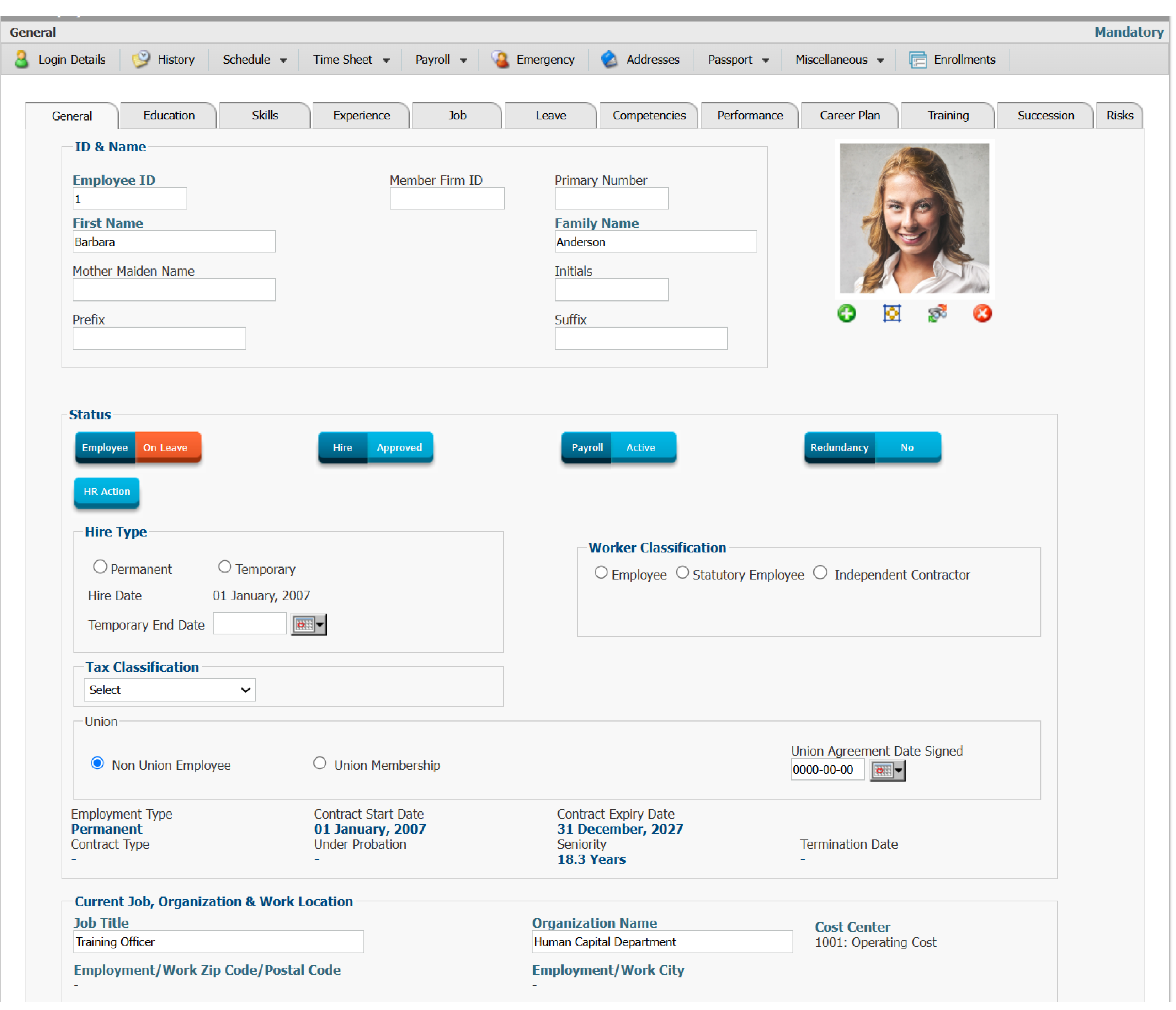
Figure: Unified Employee Electronic Record
Payroll / Time / Leave / Labor Costing / Grants
Comprehensive Payroll Management for Complex Academic Workforce
Higher education institutions manage diverse payroll scenarios including tenured faculty, adjunct lecturers, grant-funded researchers, and administrative staff, often across multiple funding sources and contracts.
Interact’s Payroll Management module provides a highly configurable, rules-driven payroll engine capable of handling complex compensation structures, multiple earnings and deductions, retroactive adjustments, and multi-entity payroll processing; integrates seamlessly with time, leave, and grants management to ensure accurate payroll costing and compliance; supports academic-specific payroll needs such as employees holding multiple roles (primary and secondary positions) with separate compensation structures and funding sources (e.g., teaching, research grants, or administrative duties), as well as stipends, overload payments, and contract-based compensation, while ensuring full auditability and statutory compliance.
Time Tracking for Hourly Staff and Adjuncts
Accurate tracking of teaching hours, office hours, and overtime for compliance and payroll.
Interact’s Time and Attendance Management module – provides a comprehensive solution for tracking employee work hours, overtime, and attendance while integrating seamlessly with leave management, biometric time clocks, scheduling and payroll; supports configurable overtime rules, more than 15 different flexible timesheet types accommodate different operational needs for a variety of industries such as construction, professional services, project-based industries, healthcare and utilities with extensive labor distribution, project-based tracking.
Academic Leave Management
Handling sabbaticals, research leaves, and compliance with policies like FMLA.
Interact’s Leave Management module is a comprehensive solution for creating and managing employee leave policies, accruals, and approvals while ensuring compliance with organizational and regulatory requirements; allows HR teams to create unlimited, customizable leave policies linked to employee groups and/or organization units; supports flexible accrual rules, including fixed or percentage-based accrual methods, or accrual based on a rate-table which can be specific to grade or seniority.
Grant-Funded Project and Labor Cost Tracking
Universities often rely on external grants for research, requiring precise tracking of labor costs against grant budgets to ensure compliance with donor requirements and avoid overspending.
Interact’s Grants Management module is tailored for research organizations and nonprofits, offering a robust solution to manage grant-funded projects by tracking labor costs and ensuring compliance with donor requirements; allows unlimited grant and donor definitions, linking them to detailed budget categories like salaries and travel, integrated directly with payroll for real-time budget adjustments as employees allocate hours to specific projects; automated budget alerts prevent overspending by notifying users when funds are low.
Recruitment / Hiring / Probation Management / Onboarding
Merit-Based Faculty Recruitment
Higher ed hiring involves rigorous screening for academic qualifications, ensuring alignment with departmental budgets and institutional standards.
Interact’s Recruitment Management module streamlines hiring by providing a requisition-based system for internal and external recruitment, ensuring alignment with workforce plans and budgets; automates the entire hiring cycle, from requisition creation and applicant screening to interview scheduling and job offer generation, reducing administrative effort while maintaining transparency; supports external recruiter management with contract and invoicing features, facilitating efficient collaboration.
Tenure-Track Probation Monitoring
Faculty on tenure track require structured probation periods with evaluations to assess teaching, research, and service.
Interact’s Probationary Period Management module offers a structured solution for monitoring and evaluating new employees during their probation period; enables HR and supervisors to create customized probation plans with specific goals, competencies, and training requirements tailored to each role; facilitates continuous assessment through progress, mid-probation, and end-of-probation evaluations, ensuring alignment between employee performance and organizational expectations.
Structured Faculty Onboarding
Orienting new hires to campus policies, resources, and academic expectations.
Onboarding Management module streamlines and automates the employee onboarding process, ensuring a structured and efficient transition for new hires; organizes onboarding into multiple stages—Before First Day, First Day, First Week, First Month and First 90 Days—each with specific tasks assigned to onboarding officers to ensure timely completion.
Talent Management
Faculty Performance Appraisals
Annual or tenure reviews need flexible, multi-rater systems to evaluate teaching, research, and service contributions.
Interact’s Performance Management module provides a flexible framework for managing employee performance evaluations; supports unplanned or planned and goal-based appraisals tailored to job roles and departments, using a 360-degree evaluation system involving multiple evaluators; offers customizable evaluation dimensions, including competencies and career factors, and enables flexible appraisal cycles for regular or project-specific reviews.
Professional Development Training
Faculty and staff require ongoing training for skills like pedagogy, research methods, and compliance, tracked against budgets.
Interact’s Training Management module provides a complete solution designed to close skill gaps and support career development through structured training plans; uses a Gap Analysis Model to evaluate employees’ current skills against job requirements, identifying training needs for current and future roles; tracks training history for performance appraisals and career development, supporting continuous learning; tracks training costs and links them with organization unit training budgets to ensure that training costs do not exceed the approved budget by project or department.
Competency Development for Academic Roles
Institutions need to define and bridge gaps in competencies like research expertise or teaching proficiency.
Interact’s Competency Management module offers a comprehensive, multi-tiered system for defining, evaluating, and developing employee competencies; supports up to 9 configurable tiers of competencies, from general organizational skills to specific job-based abilities; enables job competency analysis, competency gap evaluations, and best-fit job searches to identify and address skill gaps.
Succession Planning for Academic Leadership Planning
Higher ed institutions carefully plan for retirements or promotions in roles like department chairs or deans to ensure continuity.
Interact’s Succession Planning module is a strategic tool designed to ensure the continuity of key roles by identifying and preparing internal employees and external candidates for critical positions; includes features like succession requests, integrating with other talent management modules to cover competency evaluations, career planning, training plans and performance appraisals in support of succession planning; HR can designate critical jobs, shortlist potential successors, and assess their competencies, developing tailored career plans to close skill gaps.
Academic Job Role Standardization
Defining roles like professor levels with specific qualifications for fair compensation and recruitment.
Interact’s Job Classification module helps organizations define, manage, and evaluate job roles through a structured system that supports both grade and point classification systems; allows for detailed job definitions, including job title, salary range, industry, and qualifications, while also documenting the competencies required for each role; supports the Hay Method Job Evaluation for determining equitable pay.
HR Administration and Record Keeping
Hierarchical Organization Management
Managing complex structures like colleges, departments, and centers with matrix reporting.
Interact’s Organization Management module offers a robust framework for defining and managing an organization’s structure, allowing users to create a customized hierarchy essential for reporting, labor cost distribution, workflow approvals, and performance management; accommodates both small and large enterprises, supporting multi-entity organizations and enabling detailed classifications for each unit, such as company, branch, department, and project.
Compliant Employee Records Management
Maintaining auditable records for accreditation and regulatory compliance like FERPA.
Interact’s Unified Employee Electronic Record (UEER) module centralizes all employee data into one secure, electronic record, eliminating the need for paper files and spreadsheets; features a user-friendly, multi-tab interface that categorizes employee information into sections such as general demographics, education, skills, job details, leave records, competencies, performance, career development, training records, succession planning, and risk information; supports higher education–specific data elements including certifications, publications, speaking engagements, associations, languages, patents, and supporting materials; enables faculty and staff to maintain and update their profiles through self-service, ensuring data accuracy and reducing administrative burden; and includes comprehensive tracking of family member information and benefit enrollment, including dependents, to support benefits administration and compliance requirements.
Self-Service Portal for Faculty and Staff
Enabling independent management of HR tasks to reduce administrative burden on busy academics.
Interact’s Employee Self-Service (ESS) module is a powerful portal that enhances HR efficiency by enabling employees to manage their HR-related tasks independently; employees can view and update their own online employee records, submit leave, training, loan, and letter requests, access salary details, leave balances, and benefits; supports timesheet management, allowing employees to view and edit entries with an approval workflow.
Staff and Student Accommodation Management
Universities often provide housing for faculty, staff, and students, requiring structured allocation, tracking, and cost management of accommodation resources.
Interact’s Housing & Accommodation Management module provides a comprehensive solution for managing institutional housing by tracking housing units, room allocations, occupancy status, and associated costs; supports allocation rules based on employee grade, role, or eligibility criteria; integrates with payroll for automatic deductions (e.g., rent, utilities) and with employee records for full visibility; enables institutions to efficiently manage campus housing assets while ensuring transparency and fairness in allocation.
HR Analytics and Reporting for Accreditation
Generating reports on workforce metrics for institutional reviews and decision-making.
Interact’s Reporting & Analytics module delivers business intelligence through an extensive reporting system and Key Performance Indicators (KPIs), empowering users with actionable insights; reports, numbering more than 600 at the employer level and 100+ at the organization unit level, are constantly updated based on client needs; the KPI Dashboard provides a dynamic, real-time tool featuring 100 Key Performance Indicators (KPIs) tailored to HR management, accessible to managers, organization unit heads, administrators, and other key personnel tracking performance and quality.
Risk Management / Disciplinary Actions / Health & Safety / Facilities Management
Institutional Risk Mitigation
Identifying and addressing risks like legal compliance or operational disruptions in academia.
Interact’s Risk Management module offers a robust, integrated solution for organizations to proactively manage workforce and operational risks, leveraging self-service, workflows, and alerts within a comprehensive risk management framework; enables classification of risks as operational, financial, or legal, allowing tailored mitigation strategies like avoidance, reduction, retention, or transfer; employees can report and assess risks via self-service, while automated alerts notify stakeholders.

Figure: Risk Management
Faculty and Staff Disciplinary Actions
Managing disciplinary processes for faculty, researchers, and staff while strictly adhering to academic freedom, tenure protections, collective bargaining agreements, due process, and accreditation standards.
Interact’s Disciplinary Actions Management module supports a progressive disciplinary actions framework. It allows HR teams to define and categorize infractions based on severity with customizable steps, provides a structured step-by-step workflow from incident reporting through investigation to resolution, and securely records all actions and evidence in the employee’s Unified Employee Electronic Record for full auditability and legal compliance. The module also includes color-coded prioritization, automated alerts, and comprehensive reporting to maintain fairness and minimize institutional risk.
Campus Health and Safety Incident Tracking
Managing safety incidents, compliance with OSHA, and promoting a safe learning environment.
Interact’s Health & Safety Management module empowers organizations to manage workplace health, safety, and environmental (HSE) concerns effectively by providing a centralized system to define standardized HSE classifications, track injuries and illnesses, and maintain a detailed injury log; user-defined codes allow customized incident categorization, while robust reporting tools analyze trends, enabling proactive risk prevention.
Office Space Planning & Management
Academic institutions need effective management of limited office, laboratory, and shared workspace resources to support faculty, researchers, and administrative staff amid changing departmental needs and headcount.
Interact’s Office Space Planning & Management module helps organizations efficiently plan, track, and manage office spaces to meet manpower and recruitment needs. It enables HR and facilities teams to prevent underutilization or shortages by offering tools for tracking office space usage, managing occupancy, and handling space requests; integrates with onboarding and offboarding processes to streamline space assignments, ensuring that new hires have designated spaces from day one, and departing employees’ spaces are quickly reassigned; provides real-time occupancy tracking and vacancy forecasting to optimize space utilization and avoid overcrowding.
Parking Space Planning & Management
Universities and colleges must manage high-demand parking resources fairly and efficiently across faculty, staff, and student populations while controlling costs and ensuring accessibility.
Interact’s Parking Space Planning & Management module helps organizations efficiently manage employee parking spaces by offering a structured system for inventory definition, space assignments, and employee requests. It enables organizations to track and allocate parking spaces based on various attributes such as location & distance to the office, vehicle type options, employee’s job role, and cost; includes a self-service portal for employees to independently request parking spaces, reducing administrative tasks; once approved, if applicable, parking costs can be automatically deducted from employee payroll, streamlining payment processing.
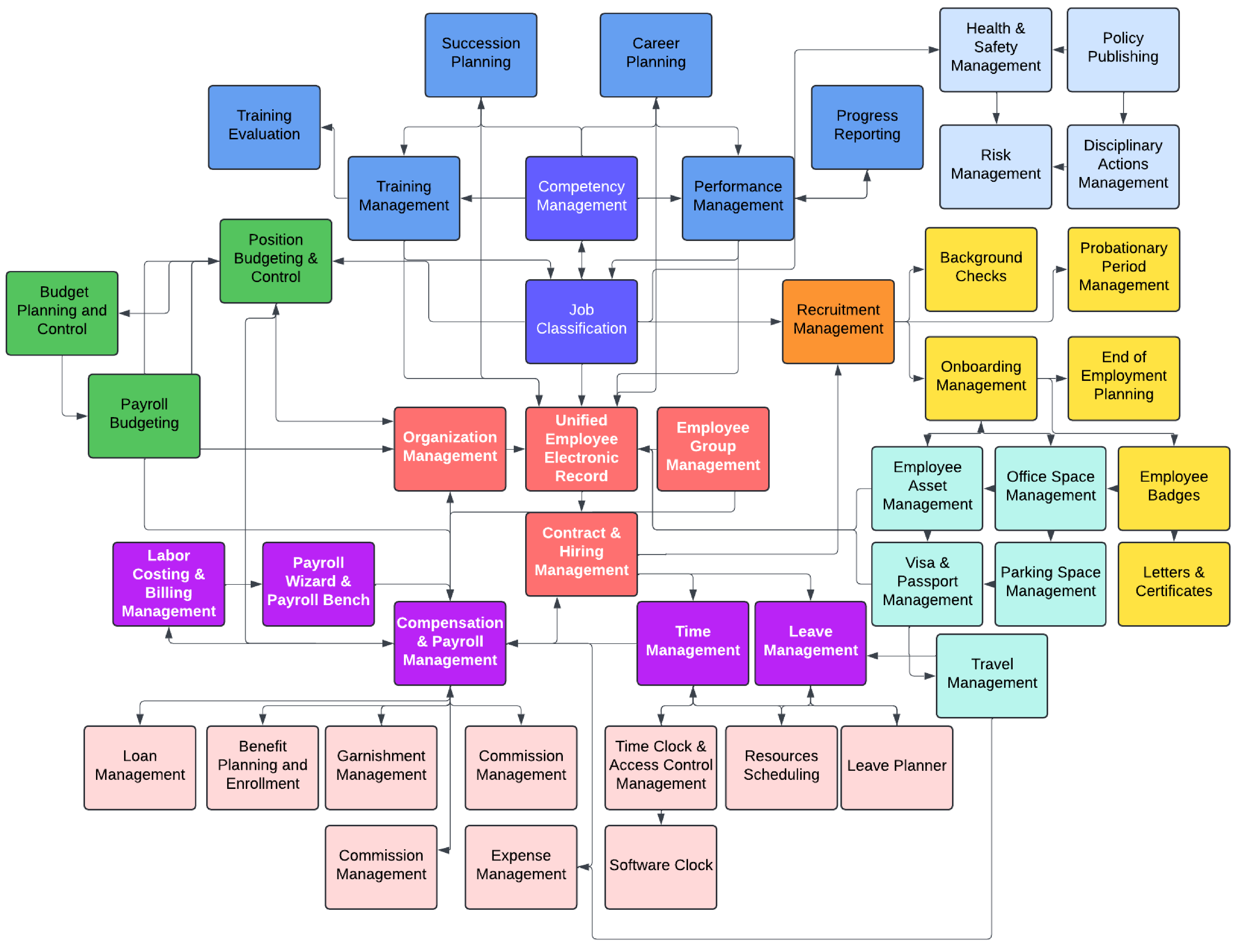
Figure: interact hrms framework
All Modules
Budgeting, Recruiting, Hiring and Onboarding
Human Resources Administration
- Organization Management
- Unified Employee Electronic Record
- Sticky Notes Management
- HR Actions Management
- Disciplinary Actions Management
- Policy Publishing
- Passport and Visa Tracking
- Housing and Accommodation
- Travel Management
- Employee Asset Management
- Parking Space Planning & Management
- Office Space Planning & Management
- Risk Management
- Health & Safety Management
- Letters & Certificates Management
- Supervisors & Managers Management
- Suggestion Box
- Offboarding Management
- Employee Alarm Management