

Interact HRMS is an enterprise human resources, payroll, time, benefits, talent, and risk management solution built as a single integrated portal with employee and manager self-service at its core. All 80+ modules share one database, one workflow engine, one alerts framework, and one access control model — eliminating duplicate data entry and ensuring every HR action, approval, and audit trail flows through a single system of record. Fully policy and parameter-driven, Interact HRMS is designed to accommodate the sophisticated requirements of civil service organizations worldwide — including position-based budget control, sophisticated organization structures, grade-and-step salary structures, multi-tier approval workflows, probationary period management, competency-based talent management and civil service commission compliance. Its global architecture supports multi-language, multi-currency, and country-specific payroll rules out of the box. Already implemented across 35 countries, Interact HRMS gives civil service agencies the configurability to meet their unique legislative, governance, and workforce management requirements.
- Position-based budget control that prevents hiring unless a funded, approved position exists
- Hard enforcement of headcount and salary limits tied to legislative appropriations, not soft warnings
- Departmental budget worksheet submission, consolidation, and formal multi-level approval workflow
- Real-time comparison of actual versus budgeted payroll expenditure with automated overrun alerts
- Budget amendment process with approval workflows for in-year adjustments
- Multi-year budget planning capability alongside annual or other periodic cycles
- Variance analysis and reporting exportable for external oversight bodies
- Salary grade-step matrix enforcing pay progression rules within approved compensation bands

HR Administration
- Formal workflow-driven personnel actions for every transaction — hire, transfer, promotion, reclassification, termination — with multi-level authorization and complete audit trail
- Support for multiple employment types in a single system — permanent, contract, temporary, daily-rated, expatriate — each with distinct policy rules
- Merit-based recruitment tied to approved positions with documented selection criteria and audit trail for civil service commission review
- Structured onboarding sequencing security clearance, medical exam, asset assignment, system access, and mandatory training before a new civil servant is cleared for duty
- Probationary period management with defined goals, competency assessments, mid-probation and end-of-probation evaluations, and automated alerts to supervisors and HR
- Progressive disciplinary management with step-by-step workflows, consistent standards across departments, and legally defensible documentation
- Offboarding workflows managing exit interviews, handover activities, asset return, access revocation, and final payroll processing with a complete end-of-employment checklist
- Organization management supporting unlimited hierarchical levels and reporting relationships across ministries, departments, agencies, and field offices — with auto-generated org charts driving workflow approvals and payroll cost distribution
- Job classification catalogue covering civil service grades, pay bands, education and experience requirements, and competency profiles — inherited automatically across recruitment, contracting, performance management, and succession planning
- Formal letters and certificates generated from templates with approval workflows and secure document storage
- Passport, visa, and work permit tracking with expiry alerts for internationally mobile and expatriate civil servants
- Policy publishing with targeted distribution by employee group, self-service acknowledgment tracking, and full version history for auditors
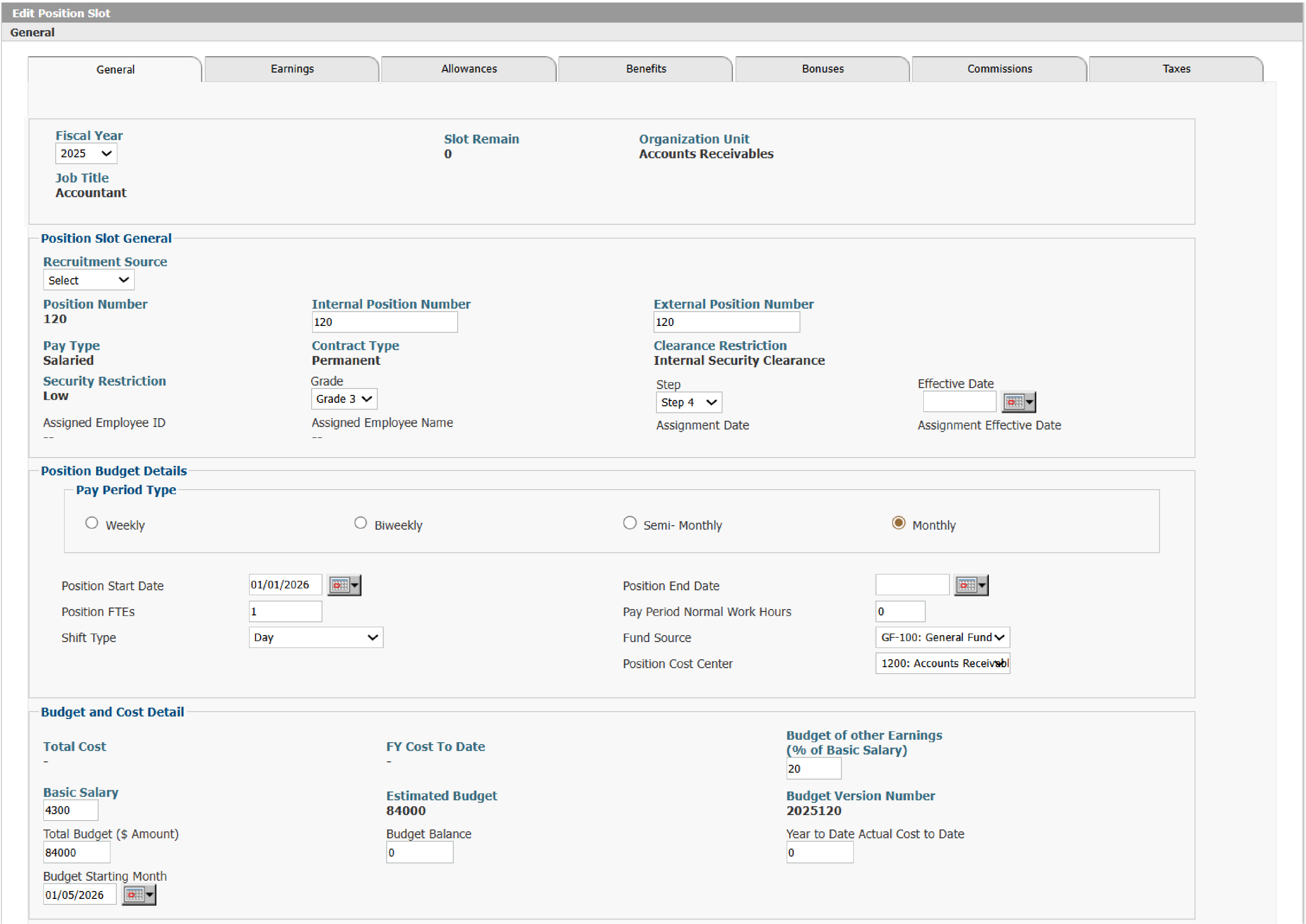
Figure: Position Slot Definition
Payroll
- Grade and step-based pay structures with rigid progression rules or negotiated market rates
- Unlimited allowance types — housing, transport, hardship, acting, uniform — each with specific eligibility rules and policy configurations
- Statutory end-of-service and indemnity payment calculations based on years of service, grade, and reason for departure with support for complex formulas including any parameter tracked in the database
- Pension fund deductions with configurable eligibility, contribution rules, and compliance with regulatory requirements
- Garnishment and third-party payment management compliant with federal and local legislation
- Loan management with automated payroll deductions and self-service tracking for employees
- Full labor cost distribution to cost centers, projects, activities, and grants traceable back to approved budget lines
- Retroactive payroll capability for handling backdated salary adjustments arising from reclassifications or delayed approvals
- Off-cycle and end-of-service payroll runs fully integrated with normal payroll cycle without manual adjustment
- Time, Attendance and Scheduling
- Multiple configurable timesheet types supporting office, field, shift, project-based, and activity-based environments within a single system
- Biometric clock integration with facial recognition, fingerprint, and card support for secure, tamper-proof attendance recording
- Jurisdiction-specific overtime rules including authorization requirements before overtime is approved and paid
- Labor cost allocation at the activity, project, cost center, and grant level for public expenditure accountability
- Resource scheduling with shift pattern management for 24/7 environments including healthcare, utilities, and security services
- Exception handling that automatically flags unauthorized absences, missed clock-ins, and timesheet discrepancies for supervisor review
- Software clock for remote and office-based staff without hardware biometric devices
- Direct integration between approved timesheets and payroll eliminating manual data transfer and ensuring audit-ready records
Talent Management
- Competency framework supporting up to 9 configurable tiers, from service-wide standards to role-specific technical requirements
- Formal performance appraisals using 360-degree evaluation with documented criteria defensible against employee challenge or tribunal review
- Goal-based appraisal cycles aligned to departmental and organizational objectives
- Promotion and career progression rules linked to seniority thresholds, qualification requirements, and competitive selection processes
- Succession planning for critical positions with formal readiness assessments, gap analysis, and development plans assigned to identified successors
- Training plans driven by competency gap analysis with costs tracked against approved departmental training budgets
- Training completion records linked to performance appraisals, promotion decisions, and succession eligibility
- Formal probationary period management with structured evaluation milestones and documented confirmation or non-confirmation decisions
Risk Management
- Classification of risks as operational, financial, or legal with tailored mitigation strategies for each type
- Risk committee and risk officer framework with formal assignment of responsibilities and documented assessment records
- Employee-level accountability for risk — linking specific risks and mitigation tasks directly to named employees in their records
- Composite risk indices based on probability, consequence, and business impact to prioritize organizational response
- Mitigation action plans with assigned tasks, deadlines, and tracked completion percentages
- Automated escalation alerts when mitigation tasks are delayed or risks remain unresolved
- Health and safety incident logging with full detail — circumstances, treatment, contributing factors — linked to employee profiles and integrated with electronic records
- Complete audit trail of all risk assessments, decisions, and mitigation actions for oversight body review
Integration with Finance Systems & Third-Party Applications
- General ledger posting of all payroll costs, allowances, deductions, and provisions to the correct GL accounts and cost centers automatically at the close of each pay period
- Bank file generation in the format required by the government’s treasury or central bank system for direct salary deposit, third-party deductions, and pension fund remittances
- Payroll reconciliation and variance reports exportable in formats compatible with the government’s financial management information system for year-end closing and external audit purposes
- Bi-directional employee data exchange with Active Directory and government identity management systems to maintain synchronized user accounts and access rights as employment status changes
- Integration with background check providers, benefit carriers, and government social security and pension fund agencies through standard file formats, APIs, or HR-XML web services
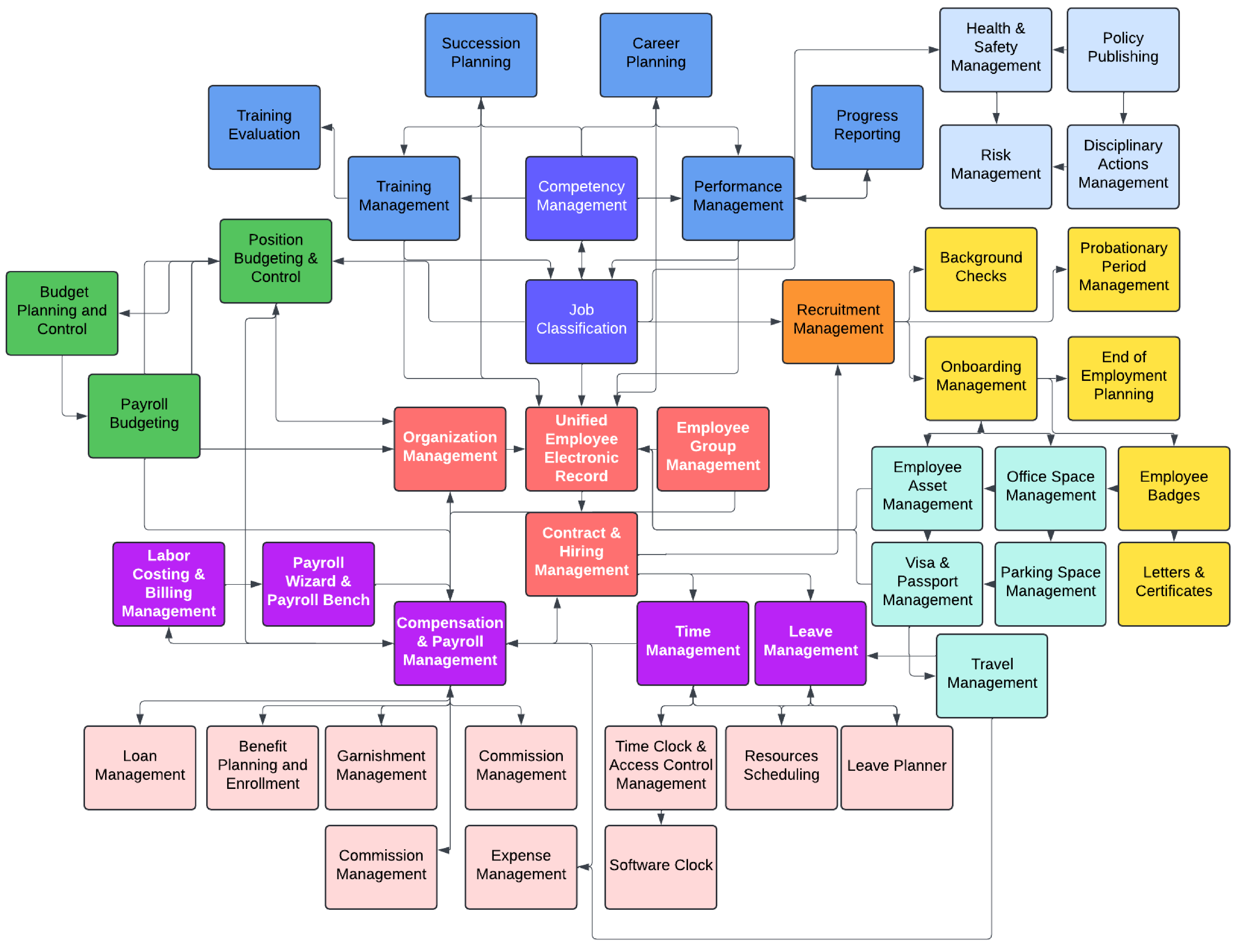
Figure: interact hrms framework
All Modules
Budgeting, Recruiting, Hiring and Onboarding
Leave, Time & Attendance Management
Human Resources Administration
- Organization Management
- Unified Employee Electronic Record
- Sticky Notes Management
- HR Actions Management
- Disciplinary Actions Management
- Policy Publishing
- Passport and Visa Tracking
- Housing and Accommodation
- Travel Management
- Employee Asset Management
- Parking Space Planning & Management
- Office Space Planning & Management
- Risk Management
- Health & Safety Management
- Letters & Certificates Management
- Supervisors & Managers Management
- Suggestion Box
- Offboarding Management
- Employee Alarm Management