

Interact HRMS is an enterprise human resources, payroll, time, benefits, talent, and risk management solution built as a single integrated portal with employee and manager self-service at its core. All 80+ modules share one database, one workflow engine, one alerts framework, and one access control model — eliminating duplicate data entry and ensuring every HR action, approval, and audit trail flows through a single system of record. Fully policy and parameter-driven, Interact HRMS is designed to accommodate the demanding requirements of international oil and gas organizations — including rotation-based scheduling, multi-country and multi-entity payroll, expatriate lifecycle management, end-of-service benefit calculations, project and AFE-based labor costing, safety-critical certification tracking, and nationalization program management. Its global architecture supports multi-language, multi-currency, and country-specific payroll and statutory rules out of the box. Already implemented across 35 countries, Interact HRMS gives upstream, midstream, and downstream operators the configurability to manage a complex, geographically dispersed, and multi-national workforce within a single system of record.
- Formal workflow-driven personnel actions — hire, transfer, promotion, reclassification, secondment, and separation — with complete audit trail supporting regulatory review and internal governance requirements in multiple jurisdictions
- Support for a highly diverse workforce within a single system — permanent employees, fixed-term contract staff, rotating shift workers, expatriates on international assignments, locally engaged national staff, and third-party contractor personnel across onshore, offshore, and remote site locations
- Expatriate and international assignment management — tracking assignment letters, home and host country details, cost-of-living and hardship allowances, tax equalization arrangements, and repatriation timelines across multiple country operations
- License, certification, and competency tracking for safety-critical and regulated roles — e.g. well operators, drilling engineers, HSE officers, process safety engineers, crane operators, and medics — with automated alerts for approaching expiry to prevent unauthorized deployment

- Structured onboarding workflows sequencing mandatory safety inductions, site access badging, medical fitness clearances, competency verifications, and equipment authorizations before any employee or contractor is deployed to operational sites
- Apprenticeship, graduate, and national development program management — with rotation scheduling, milestone evaluations, and structured progression pathways supporting local content and nationalization obligations
- Position-based organizational management with formal headcount control — enabling workforce planning aligned to approved manning levels for platforms, rigs, refineries, and processing plants
- Progressive disciplinary management with consistent, documented application across geographically dispersed operations — onshore plants, offshore platforms, pipeline corridors, and remote field camps — with legally defensible records supporting labor relations proceedings in multiple jurisdictions
- Policy publishing with targeted distribution by employee group, site, employment category, and nationality — with electronic acknowledgment tracking for HSE, security, and mandatory regulatory compliance policies
- Merit-based recruitment tied to approved positions with documented selection criteria, audit trail, and equal employment opportunity compliance — including structured management of internal mobility and international transfer processes
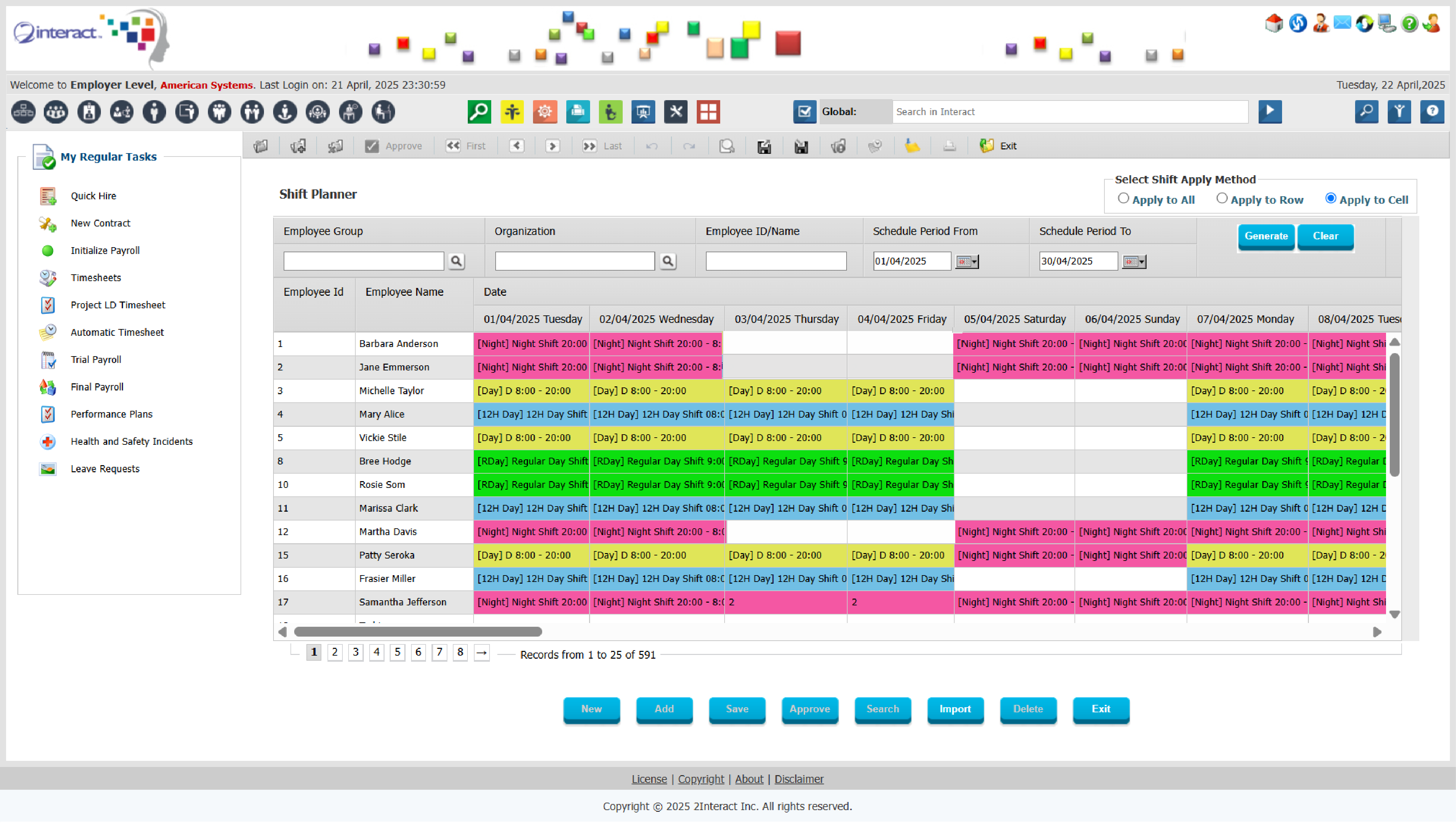
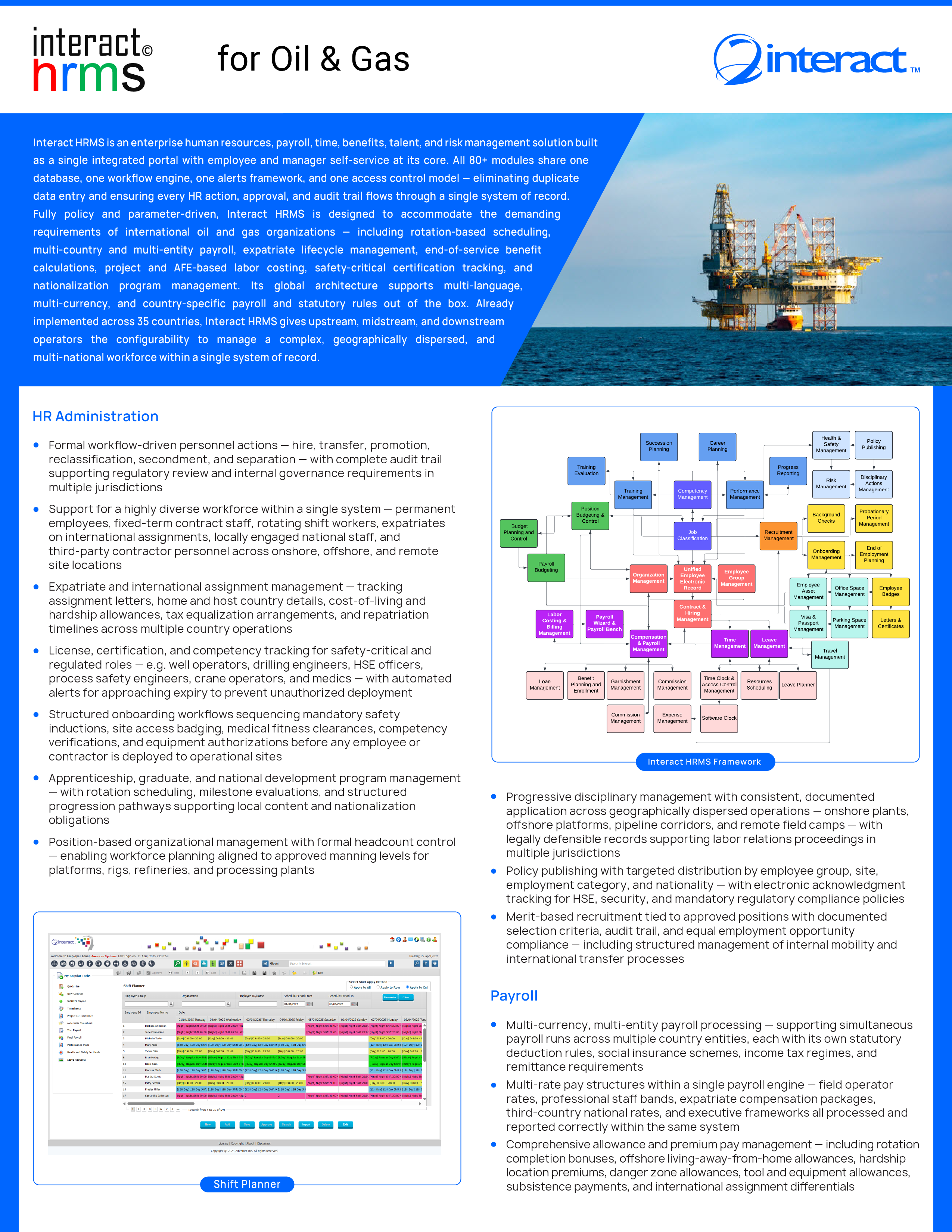
Figure: Shift Planner
Payroll
- Multi-currency, multi-entity payroll processing — supporting simultaneous payroll runs across multiple country entities, each with its own statutory deduction rules, social insurance schemes, income tax regimes, and remittance requirements
- Multi-rate pay structures within a single payroll engine — field operator rates, professional staff bands, expatriate compensation packages, third-country national rates, and executive frameworks all processed and reported correctly within the same system
- Comprehensive allowance and premium pay management — including rotation completion bonuses, offshore living-away-from-home allowances, hardship location premiums, danger zone allowances, tool and equipment allowances, subsistence payments, and international assignment differentials
- Rotation and shift-based payroll calculation — processing back-to-back offshore or remote site rotations with correct calculation of rotation pay, travel days, standby days, and on-leave days for common oil and gas roster patterns such as 28/28, 14/14, and 21/21
- Tax equalization and hypothetical tax calculations for internationally mobile employees — ensuring expatriates remain tax-neutral relative to their home country tax position regardless of host country tax obligations
- Retroactive pay processing for collective agreement settlements, reclassification outcomes, and offshore compensation reviews — accommodating the multi-year bargaining cycles and regulatory compensation reviews common in the sector
- Statutory end-of-service benefit calculations — including gratuity accruals, indemnity payments, and end-of-contract entitlements under multiple labor law frameworks governing large portions of the international oil and gas workforce
- Project and cost center labor cost distribution — allocating payroll expenditure to well numbers, field codes, project AFEs (Authorizations for Expenditure), capital versus operating cost categories, and joint venture cost recovery accounts for accurate production cost reporting
- Emergency and supplemental payroll run capability — enabling out-of-cycle processing for emergency mobilizations, unexpected terminations, or short-notice charter payments without disrupting the standard payroll cycle
Benefits Management
- Multi-plan benefits administration within a single system — managing separate benefit schedules for permanent local nationals, expatriates, third-country nationals, and contract staff, with the correct plan automatically applied based on employment category, nationality, and grade
- Comprehensive medical and international health insurance plan administration — enrollment, dependent management, plan tier assignment, premium tracking, and insurer remittance file generation for the international private medical coverage central to expatriate compensation packages
- End-of-service gratuity and defined contribution plan administration — accrual tracking, contribution rate management, vesting schedule enforcement, and reconciliation for configurable retirement and separation benefit structures
- Company housing and accommodation benefit administration — tracking housing allowance entitlements, company-provided accommodation assignments, and associated utilities, where housing forms a significant component of total remuneration for expatriate and rotational staff
- Education and schooling allowance administration for expatriate families — tracking entitlements by grade and family status, validating claims against approved school lists, and processing reimbursements within policy limits
- Repatriation, home leave, and annual travel benefit management — tracking flight entitlements by grade, routing, and family size, processing travel claims, and monitoring utilization against policy allowances for internationally mobile employees
- Long-term disability and income protection plan administration — addressing elevated occupational risk exposure for field workers, drilling crews, process operators, and offshore personnel
- Flexible and voluntary benefit enrollment through employee self-service — supporting open enrollment and qualifying life event changes across a geographically dispersed, multi-nationality workforce with varying local benefit entitlements
- Accurate benefit cost reporting by entity, project, cost center, and joint venture — enabling recovery of employee benefit costs through joint venture billing and production cost reporting frameworks
Time, Attendance, Leave and Scheduling
- Rotation roster scheduling for offshore platforms, onshore remote sites, and LNG facilities — supporting industry-standard rotation patterns including 28/28, 21/21, 14/14, and bespoke field rosters, with automated calculation of work days, travel days, and off-rotation leave entitlements
- Multiple timesheet types within a single system — project-coded timesheets for capital drilling and construction programs, shift-based timesheets for process operators and control room staff, and standard timesheets for office-based corporate functions
- Leave administration calibrated to multi-country and union requirements — managing annual leave accruals, rotation leave, compassionate leave, Hajj leave, national service leave, and long-service leave with accrual rules configurable by employment category, jurisdiction, and years of service
- Biometric and access-controlled time capture for onshore facilities, refineries, and processing plants — with mobile and offline clock capability for remote field locations, drilling sites, and pipeline crews operating without reliable network connectivity
- Fatigue risk management for safety-critical roles — tracking consecutive hours worked, mandatory rest periods between rotations, and cumulative fatigue exposure for drilling crews, process operators, and offshore installation managers in compliance with recognized fatigue risk frameworks
- Contractor and contingent workforce time tracking integrated with vendor management — enabling real-time monitoring of blended workforce costs and man-hours across permanent employees and the large contract labor base typical of capital project execution phases
- Direct timesheet-to-payroll integration with automatic posting of labor costs to well numbers, project AFE codes, cost centers, and joint venture accounts generated from approved time records — eliminating manual re-keying and supporting accurate joint venture cost recovery
- Emergency mobilization scheduling — activating standby personnel, managing short-notice rotation changes driven by well control events, and ensuring rapid workforce deployment with complete time and cost records for insurance and regulatory reporting
- Workforce scheduling dashboards providing real-time visibility of headcount by site, rig, platform, and project — enabling operations supervisors to monitor manning levels, identify coverage gaps, and manage rotation handovers across distributed field locations
Talent Management
- Technical competency framework covering the full range of upstream, midstream, and downstream roles — from field operator and rig crew through drilling engineer, reservoir geoscientist, and refinery process engineer — with competency levels linked to licensing, authorization, and career progression requirements
- Performance appraisal system with evaluation criteria calibrated to operational roles — weighting HSE performance, safe work practices, production targets, reliability metrics, and technical competency alongside behavioral indicators, rather than relying solely on financial measures
- Succession planning for critical operational and technical leadership roles — platform managers, drilling superintendents, reservoir engineering leads, and HSE managers — where deep technical expertise and operational experience represent long lead times that cannot be recovered quickly if key roles become vacant unexpectedly
- Nationalization and local content talent development program management — tracking development plans, competency progression, rotation completions, and mentorship assignments for national employees under government-mandated or equivalent local content development programs
- Structured training management administration for mandatory, safety-critical, and regulatory qualifications — Basic Offshore Safety Induction and Emergency Training (BOSIET), Helicopter Underwater Escape Training (HUET), H2S awareness, confined space entry, first aid, and process safety certifications — with training completion gating preventing deployment without current valid certification
- Skills gap analysis and targeted upskilling programs — supporting the energy transition workforce, including retraining engineers and technicians from conventional hydrocarbon roles into carbon capture, hydrogen, and renewable energy operations as companies diversify their asset portfolios
- Leadership development programs building the next generation of operational and functional leaders from within the technical workforce — preserving institutional knowledge of aging assets, legacy systems, and field operating conditions that is irreplaceable if lost through retirement waves
- International mobility and career pathing tools — tracking cross-country assignment history, international experience portfolios, and development agreements for globally mobile professionals whose careers span multiple country operations
Risk Management
- Risk identification and classification across operational, financial, and legal risk categories — enabling HSE managers, HR, and operations leaders to formally register workforce and operational risks with defined ownership, ensuring every identified risk in the organization has an accountable risk owner and a documented response plan
- Composite Risk Index calculation based on assessed probability and consequence for each registered risk — providing a quantified, defensible risk score that enables prioritization of mitigation effort and supports regulatory reporting to national petroleum authorities and JV partner governance committees
- Employee self-service risk reporting — field workers, drilling crews, and offshore personnel can submit risk observations directly through the ESS portal or mobile app, creating a culture of proactive risk identification and ensuring frontline intelligence reaches risk owners before incidents occur
- Structured mitigation strategy management with four configurable response types — avoidance, reduction, retention, and transfer — each with assigned tasks, responsible parties, target dates, and real-time progress monitoring, replacing informal action logs with a governed, trackable mitigation framework
- Visual risk plotting through graphic risk matrix displays — providing operations managers and HSE leadership with an intuitive view of the organization’s risk landscape, immediately identifying which risks require urgent escalation and enabling portfolio-level risk conversations at executive and board level
- Occupational health and safety incident management with standardized HSE classifications, comprehensive injury and illness logs linked to individual employee records, user-defined incident codes, and trend analysis reporting — supporting OSHA recordkeeping obligations and proactive safety intervention for the elevated-risk field workforce across onshore, offshore, and remote site operations
- Complete audit trail of all risk assessments, mitigation actions, incident records, and compliance decisions — supporting internal audit, national petroleum regulator inspections, JV partner governance reviews, and legal proceedings arising from workplace incidents or regulatory investigations
Technical Capabilities
Workflow Management
- Fully configurable multi-step approval workflows for every HR action — hire, transfer, expatriate assignment, rotation change, safety authorization, and separation — with approval chains defined by action type, grade, cost center, or legal entity
- Parallel and sequential routing with criteria-based conditional steps — automatically directing actions to HR, Finance, Operations, and JV partner representatives based on predefined rules without manual intervention
- Automatic escalation on SLA breach and delegation management for field absences and offshore rotations, ensuring no approval bottleneck halts time-sensitive operational decisions
- Tamper-evident audit trail of every approval, rejection, and comment — supporting JV partner governance, petroleum regulator inspections, and internal compliance reviews
Alerts Management
- Unlimited configurable alert rules against any HRMS data field, delivered via in-system notification, email, and SMS — configured by HR administrators with no developer involvement
- Proactive certification and compliance alerts — expiry warnings for BOSIET, HUET, H2S, offshore medical fitness certificates, contractor licences, insurance certificates, and passport and visa validity for expatriate staff, with configurable lead times
- Fatigue threshold alerts for safety-critical roles, headcount budget breach warnings, and succession gap notifications when a critical role loses its identified successor — converting HR data into operational risk intelligence

Figure: Oil Mining
Mobile Applications & Self-Service
- Support for mobile applications and a fully integrated Employee Self-Service portal — enabling employees to submit leave requests, timesheets, and training requests, and view payslips, certification status, and leave balances without HR involvement
- Manager self-service for approvals, team compliance dashboards, and headcount-versus-budget visibility from any device — reducing administrative load on HR teams across dispersed field locations
- Offline transaction queuing for remote sites and offshore platforms with intermittent connectivity, GPS-enabled mobile clock-in with geo-fencing, and biometric device authentication for secure field access
Reporting & Analytics
- 600+ pre-built reports and a real-time KPI dashboard with 100+ configurable workforce indicators covering headcount, payroll cost, turnover, overtime, training completion, certification compliance, and safety incident rates — filterable by entity, cost center, project code, nationality, and location
- Oil and gas-specific reporting across local content compliance, JV labor cost recovery by AFE code, expatriate cost analysis, rotation adherence, and payroll cost by project code for government production cost reporting
Secure Data Exchange & API Integration
- Fully documented REST API, role-scoped access control, and complete transaction logging — supporting bi-directional integration with ERP and finance platforms (SAP, Oracle, etc.) for payroll journal posting, labor cost allocation, and headcount reporting
- Integration with payroll banking systems, government statutory portals for multi-jurisdiction tax and social insurance submissions, physical access control and biometric infrastructure, HSE management platforms, learning management systems, and Active Directory/LDAP for single sign-on
- MFA support, granular role-based access control, and data residency options for jurisdictions requiring in-country storage of HR and payroll data
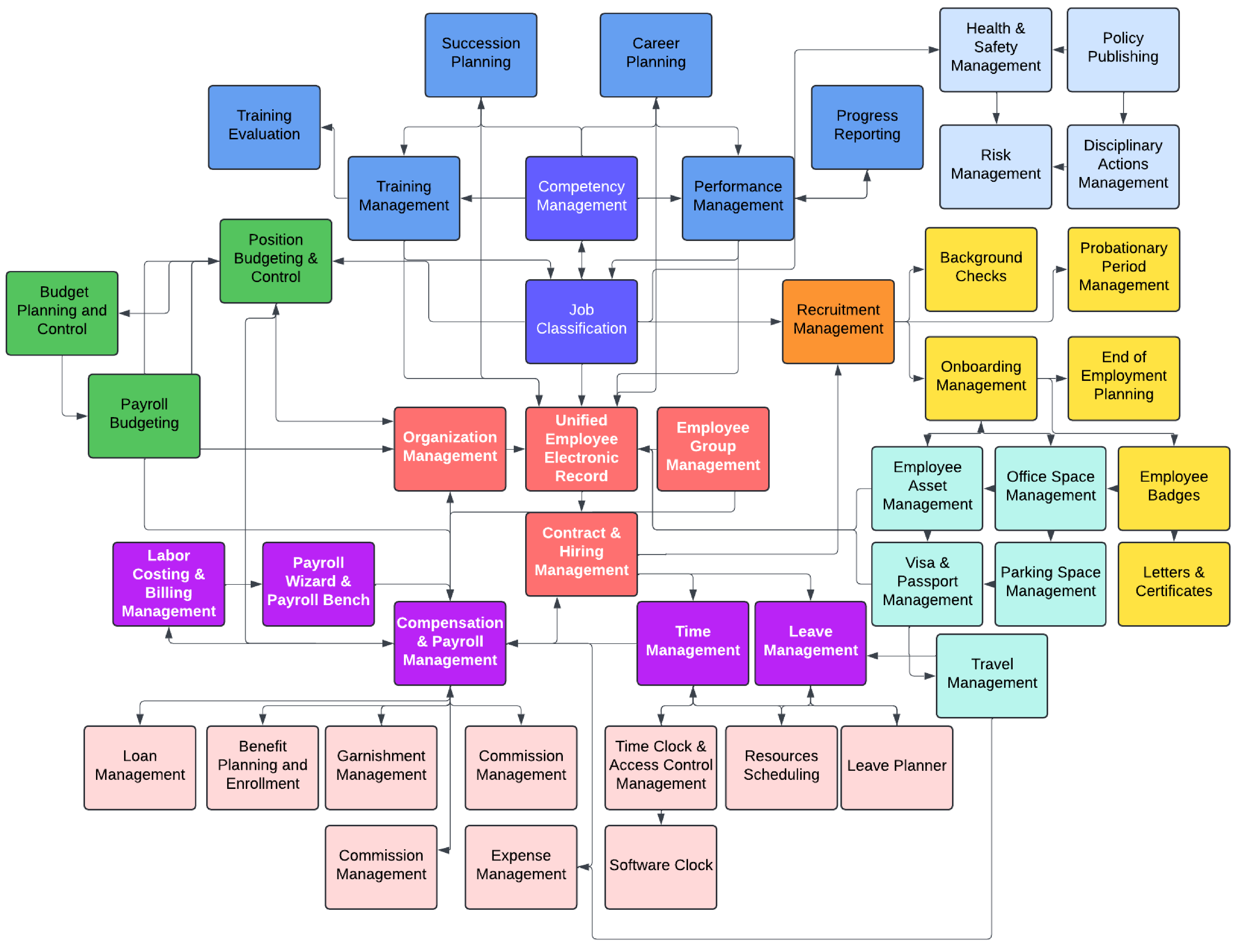
Figure: interact hrms framework
All Modules
Budgeting, Recruiting, Hiring and Onboarding
Leave, Time & Attendance Management
Human Resources Administration
- Organization Management
- Unified Employee Electronic Record
- Sticky Notes Management
- HR Actions Management
- Disciplinary Actions Management
- Policy Publishing
- Passport and Visa Tracking
- Housing and Accommodation
- Travel Management
- Employee Asset Management
- Parking Space Planning & Management
- Office Space Planning & Management
- Risk Management
- Health & Safety Management
- Letters & Certificates Management
- Supervisors & Managers Management
- Suggestion Box
- Offboarding Management
- Employee Alarm Management