
2Interact, Inc. use a tried and tested methodology which has been developed over many years and is the result of their experience implementing their own systems and other large systems in many industries and government environments around the world. This “2Interact Implementation Methodology” consists of different phases in the project and will be applied in this case too, each phase is described further below.
For a project to be successfully implemented within budget and within the planned time-frame, it is essential that the following practices are adhered to throughout the project to avoid delays.
Following Implementation Methodology – It is essential that the Interact Implementation Methodology is adhered to at all times and followed as designed as this is the only proven method that will ensure Deployment On Time and Within Budget.
80/20 Rule – The 80/20 Rule requires both parties to distinguish and prioritize among their requirements and change requests as part of their Validation Feedback. Clients are expected to classify their feedback as either part of the 80% essential requirements or 20% less critical requirements which can be implemented at a later date. The way to obtain a timely Go-Live of the project is to focus on the 80% essential transactions and processes required for the system to Go Live and to postpone other “Wish List Items” till a later date. Items which need to be postponed and be classified as 20% include, but are not limited to, feature requests re: ease-of-use when a reasonable solution already exists, cosmetic changes to look & feel of the application, automation of exceptions which do not occur frequently and in every pay-cycle and can be handled through manual intervention as well as any automation which is not essential to save significant time for many users. It is essential to focus on key functions and transactions which constitute the bulk of transactions processed by the Client to ensure that Client can go live as soon as possible with the vast majority of the available functionality and has the right tools available to handle unique or rare cases without delaying the go-live of the project.
Focus – Focus is very important in managing the implementation of a large enterprise software such as Interact SSAS, thus once the plan is devised, the focus needs to be on achieving the milestones defines within the plan. There should be no deviation from the implementation milestones, unless for good reason that adds value to the
implementation timetable and the outcome of the implementation.
All Stakeholders – All stakeholders must be involved in the project in all key meetings as the solution is process-based and seamlessly integrated and it is important that all Stakeholders understand the impact and importance of the functions in the system which may affect their operations even if they do not have a direct relation to their area of responsibility. Stakeholder input is key throughout the project to avoid having to redo the work.
Validation Feedback must cover ALL Modules. Validation Feedback will be provided by the Client to the Provider and should cover all modules of the application which will be implemented due to the many interdependencies. 2Interact will only conduct a formal review of this Validation Feedback once the Validation Feedback for all modules has been submitted by Client. It is critical that the Validation Feedback is provided comprehensively and by process as Interact SSAS is a process-based application.
Sign Off on Each Phase. After completion of each Phase of the Project, Client Project Manager and Stakeholders must sign off on the key deliverables of that Phase in order for the next Phase of the Project to start so that progress can be measured against fixed deliverables.
Sign Off on Validation Feedback. After Completion of Validation Feedback of each Module the Feedback provided will be signed off by the Project Manager and Stakeholders to confirm that the Feedback is complete and accurate and represents their best effort to confirm any and all changes required to the particular Module’s functionality or processes.
Management Support & Policy/Process Decisions. It is essential that executive management is directly involved in the project and provides timely decisions on policy matters which need to be clarified due to ambiguity or require changes to improve efficiency when implementing in an automated and integrated software solution. Client must appoint one person for the project to make procedural decisions and sign-off on these decisions in a timely manner to avoid any project delays.
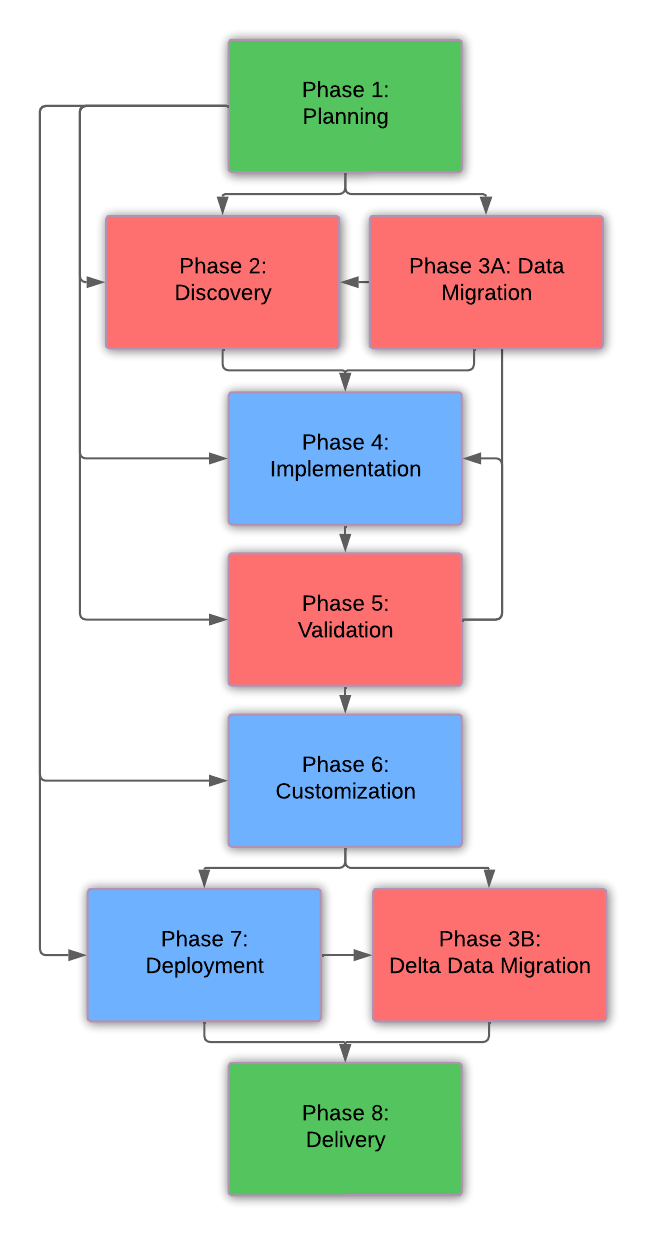 Figure 1: Interact Implementation Methodology
The basic phases of the 2Interact Implementation Methodology are the following:
Phase 1: Planning
Phase 2: Discovery
Phase 3: A: Data Migration Stage 1, B: Data Migration Stage 2
Phase 4: Implementation
Phase 5: Validation
Phase 6: Customization
Phase 7: Deployment
Phase 8: Delivery
Phase Description
Phase 1 – Planning – The planning component is used to plan the project and consists of:
- Project Kickoff Meeting
- Project Stakeholders and Responsibilities
- Preliminary Project Plan
- Prerequisites
- Change Control
The Planning Phase is important because it ensures all parties are on the same page with their expectations for the project, resources that need to be allocated and the manner in which the project will be run. Open communication is essential to ensure that issues are addressed head-on before they lead to delays or complications down the road. The Preliminary Project Plan which is delivered at this stage is Preliminary since it is based more on prior experience than on actual data regarding a Client’s exact needs, environment, policies and quality of data to be migrated. The Project Plan will be reviewed and updated after each Project Phase and sometimes multiple times during a single Project Phase depending on what exactly is found during the different stages of a Project Phase.
The Planning Phase is a joint Phase but the majority of the input will come from the Vendor whereas the Client will be able to give Feedback before the first Preliminary Project Plan is finalized.
Phase 2 – Definition / Discovery – This component of the methodology is used to define and collect the data required using Discovery Spreadsheets for the implementation of the SSAS applications and consists of:
- Foundation Definition
- Policies, Procedures, and Processes Definition
- Data Conversion and Migration
- Review and Update Plan
- Review and Acceptance
Capturing all Foundation Data, Policies, Procedures and Processes as well as the Data which needs to be migrated, is absolutely critical as it will form the basis for the rest of the project. Incorrect or incomplete policy and data capture will lead to additional work later on and may significantly delay or disrupt the project if found out much later only. For this reason, we work with very specific Discovery Spreadsheets which are designed for the sole purpose of capturing all relevant data of a client in the specific field of Social Security and will be used to ensure that no important elements are overlooked and that all data is complete which is obtained from the client.
The Discovery Phase is also a phase where both parties work closely together, however the majority of the effort will be on the Client’s side. Initially, the Vendor will explain in detail the meaning of the various Discovery Spreadsheets, their purpose and the logic of the sequence to follow as well as the relationships between the different spreadsheets. Once the Client is clear on how to fill in these Discovery Spreadsheets, it is up to the Client who is familiar with the policies and the data to complete the Spreadsheets in detail and to review them for accuracy and completeness before submitting them to the Vendor.
Incorrect, misunderstood or incomplete submissions can lead to incorrect, misunderstood or incomplete setup afterwards in the Implementation Phase, which will have further impact on the project and ultimately require valuable work to be undone and redone so it is essential that this Phase of the project is handled with care, with frequent and clear communication between both parties to avoid misunderstandings.
It is important to understand also that while the Discovery Spreadsheets are the main tool to capture the policy and baseline data of the Client, this may not be sufficient in the case of unique requirements or requirements which cannot easily be documented in a standardized manner. For this reason, additional meetings will be conducted to capture general information and clarify specific needs more in detail and with examples.
It is very important for the success of the project that the Client carefully reviews all their submissions and signs off that these are final, accurate and complete, to ensure that there is no frequent going back to original submissions for corrections and omissions after the fact.
Phase 3 – Data Migration – This phase consists of the Data Migration of all key SSAS data and is initiated already during the Discovery Phase as it is important to start the Data Migration as soon as the key policies have been documented and discovered in the Discovery Phase.
- Review Data Migration Spreadsheets
- Complete the Data Migration Spreadsheets
- Review and Import the Data Migration Spreadsheets
- Client Review of Migrated Data
- Data Migration Sign-Off
During the Data Migration phase, the Interact SSAS consultants will review the Data Migration Spreadsheets with the Client to ensure that everything is clear about the structure and content of the data that is required.
It will be the Client’s responsibility to complete the Data Migration spreadsheets as per the format required. Client will need to review carefully before submitting to ensure that no incorrect data is submitted.
2Interact will then review the submitted Data Migration sheets and import them into the application. Once this is done Interact SSAS consultants will review the migrated data and show the same to the Client Project Team who will then need to Validate, during the Validation Phase, that the data was correctly migrated and provide detailed feedback in the case of any discrepancies uncovered.
After acceptance of the Migrated Data, the Client Project Team signs off on the Data Migration and continues with the Functional Validation, using its own data in order to work with scenarios that are as close as possible to reality while learning how the system works.
The Data Migration takes place in two Stages:
Stage 1: starts during Discovery Phase
- the Data Migration Spreadsheets are shown and explained to the client,
- client extracts all the historical data up to a certain cutoff date from its current systems and formats the extracted data to match the required formats,
- client provides completed Data Migration Spreadsheets to 2Interact
- 2Interact imports the Data Migration Spreadsheets into Interact SSAS
- client reviews data that has been loaded
Stage 2: starts during Deployment Phase
- client extracts the ‘delta’, i.e. the difference in transactions and new data entered into their system since the cutoff date
- client provides the ‘delta’ in final set of Data Migration Spreadsheets to 2Interact
- 2Interact imports the Data Migration Spreadsheets into Interact SSAS
- client reviews data that has been loaded
Phase 4 – Implementation – This component consists of the setup of the software and includes:
- Prepare Implementation Environment
- Software Installation
- Foundation Setup
- Policies Setup
- Workflow Setup
- Review and Acceptance
The Implementation Phase is a Phase which is mostly and primarily the responsibility of the Vendor as this is where the Vendor will configure the application (Interact SSAS) to support the specific policies of the Client, i.e. the business rules, and load the system with underlying Foundation Data. These implementation tasks are entirely based on what was collected during the Discovery Phase and the success and accuracy of this phase is therefore fully dependent on the accuracy and completeness of the prior Phase.
If it is found that some of the requirements submitted by the Client during the Discovery Phase require actual customization (i.e. source code changes) after careful review and understanding of such requirements, then the Vendor will also write up specifications and initiate the development of any new features needed to fully support the needs of the Client.
After the Implementation is complete, the Vendor will review from their side and then present the setup to the Client for initial Review and Acceptance.
Phase 5 – Validation – This component consists of the validation of the Interact SSAS setup, transactions and processes against the setup of the foundation and policies and consists of the following:
- Pre-Validation User Training
- Process/Transaction Cases
- Validate Processes
- Review and Acceptance
Once the Implementation Phase is complete, it is time to move to the Validation Phase. During this Validation Phase, the Client’s Stakeholders will be trained on how to process transactions using various cases which have been agreed upon in advance to ensure that all important types of cases are handled and clearly validated.
The Validation Phase is not a “Testing Phase” as the Interact SSAS application is not a new application which needs to be ‘tested’. It is a Validation Phase whereby the Users perform actual transactions using real data, their own data, and validate, i.e. verify, that the system provides the correct and expected / desired Output after a specific Input has been given to the system. This is a very important Phase of the Project and it is essential that this is done with great care as an incorrect or incomplete Validation Phase means that issues will most likely be discovered only after Delivery/Go-Live which can have many negative consequences.
The Validation Phase is largely the responsibility of the Client as it is the Client’s Stakeholders who need to learn how to work with the application and how to process transactions in order for them to be able to compare the system’s output against their own expected / desired Output. The Feedback which is given during this Validation Phase will be used to make corrections to the Configuration/Setup of the system.
In order for Client Coordinators to be able to do this work correctly, they must have time to focus on it, they must be able to attend the training sessions at the start of the Validation Phase and be able to practice right after the training with real-live cases and scenarios.
Another important Outcome of the Validation Phase is that Client Stakeholders will gradually become very familiar with the logic of the system, through frequent practice they will become very comfortable with navigating the system and how to process their transactions which will be identical to the way they will be processing transactions afterwards when they go live.
It is important for Client Stakeholders to make their mistakes during this Validation Phase and learn from these mistakes. It will enable them to further understand the logic of the system and learn how to look for reasons for unexpected outcomes and better grasp the processes and underlying setup of the system. This in turn will enable them to avoid mistakes in the future and know which action to take to remedy any mistakes made when the system is live.
Very thorough and careful validation is a prerequisite to the next phase as the project can only go live once the setup has been validated and confirmed to be correct and all users are familiar with the system and how to operate it independently.
Validation Feedback must cover ALL Modules. Validation Feedback will be provided by the Client to the Provider and should cover all modules of the application which will be implemented due to the many interdependencies. 2Interact will only conduct a formal review of this Validation Feedback once the Validation Feedback for all modules has been submitted by Client. It is critical that the Validation Feedback is provided comprehensively and by process as Interact SSAS is a process-based application.
In addition, it is essential that the following practices are adhered to throughout the project to avoid delays.
Sign Off on Each Phase. After completion of each Phase of the Project, Client Project Manager and Stakeholders must sign off on the key deliverables of that Phase in order for the next Phase of the Project to start so that progress can be measured against fixed deliverables.
Sign Off on Validation Feedback. After Completion of Validation Feedback of each Module the Feedback provided will be signed off by the Project Manager and Stakeholders to confirm that the Feedback is complete and accurate and represents their best effort to confirm any and all changes required to the particular Module’s functionality or processes.
Management Support & Policy/Process Decisions. It is essential that executive management is directly involved in the project and provides timely decisions on policy matters which need to be clarified due to ambiguity or require changes to improve efficiency when implementing in an automated and integrated software solution. Client must appoint one person for the project to make procedural decisions and sign-off on these decisions in a timely manner to avoid any project delays.
Phase 6 – Customization – This component consists of 2Interact implementing the customization of items which were raised as Change Requests as a result of the Validation Phase. This customization is separate from regular policy configurations using existing functionality of the system. Customization requires source-code changes which are necessary to introduce new functionality and new methods which are essential to support a specific client requirement that is key to the client’s way of operating and their compliance with social security regulations. This phase consists of:
- Review and Finalizing the Validation Feedback Signed Off Documents
- Implementing all Customization Items as per Validation Feedback Signed Off Documents
- Testing all Customization Items as per Validation Feedback Signed Off Documents
- Present and Review with the Client all Customization Items as per Validation Signed Off Documents
- Sign-Off by the Client of all Customization Items as per Validation Sign-Off Documents
The basis for the Customization is the set of Signed Off Documents which resulted from the Validation Phase. These documents must address in detail the exact change that is required so that the implemented Customization can correctly reflect the needed requirement.
Phase 7 – Deployment – This component of the methodology consists of planning and preparing the software for go live and includes:
- Prepare Production Plan
- Prepare Production Environment
- Install Software
- Deploy Setup from Implementation
- Final Data Migration
- Production Support Procedures
- Review and Acceptance
This is the last Phase prior to Delivery, it is used to prepare everything for final Delivery and subsequent Go-Live. As part of this phase, a final Data Migration will be required to ensure that all the changes made to the Data in the actual live environment of the legacy system over the previous Validation Period will be reflected in the new Data that is to be migrated. This Data Migration should include all data required for the full operation of a Live System, including not only the full setup and configuration of the system but also all historical data required to properly calculate all transactions.
Detailed and careful attention must be paid to all steps in this phase and the Production environment will be prepared together with the Client (in the case of On-Premise deployment where the Cloud Environment is under control of the Client).
Phase 8 – Delivery – This component consists of the go live of the software applications and the production support and includes:
- Go Live
- Post-Production Support
Note that each component of the methodology translates into a phase in the implementation of a set of related Interact SSAS applications.
Implementation Risk and Risk Mitigation
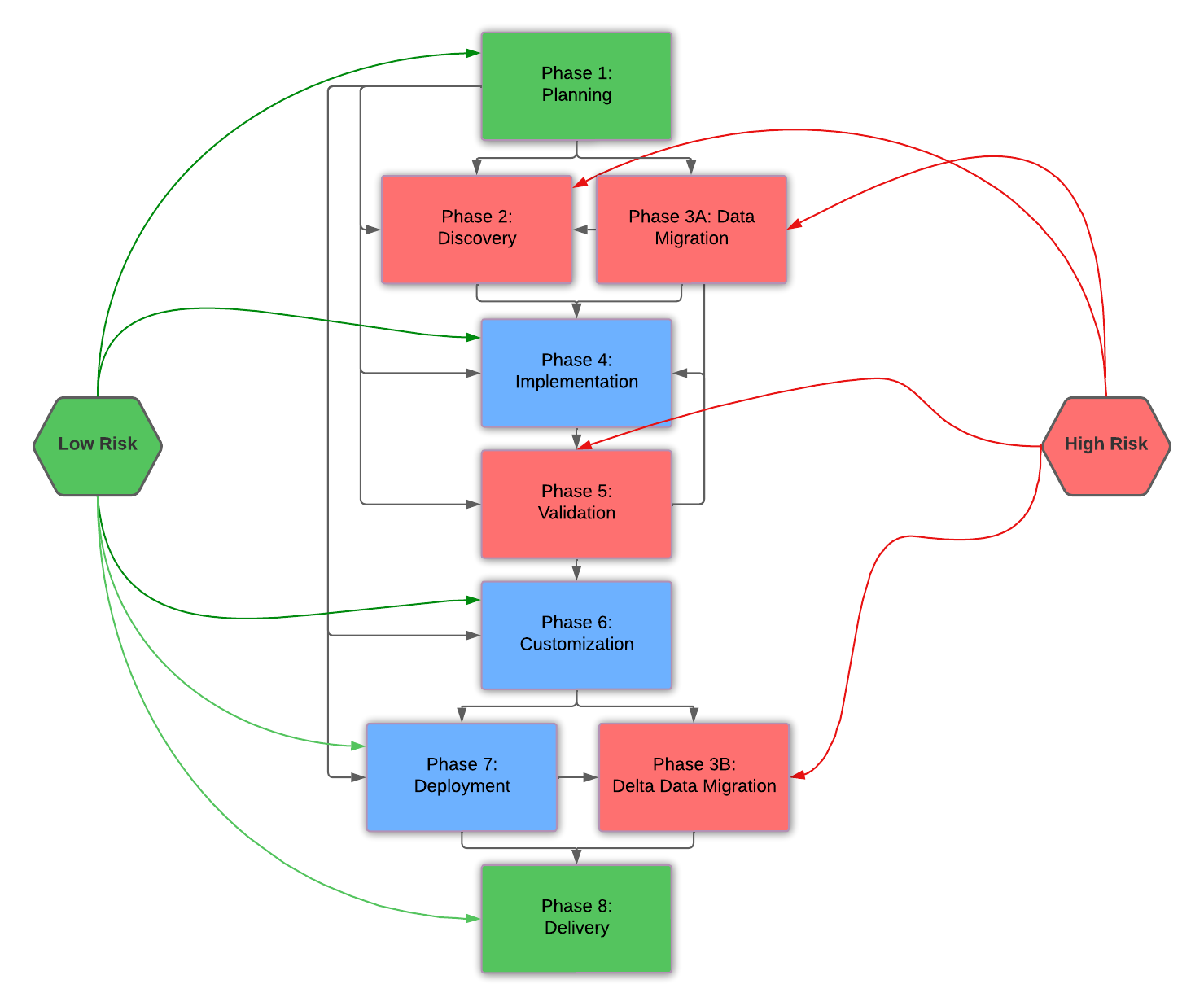
Figure 2: High Risk vs Low Risk Phases
High Risk Phases are Phases which can lead to major delays and cost overruns if they are not executed properly and as per plan. The main reason for this is that an implementation project is done in a sequential manner and if a key phase, which will directly affect all other phases, is executed incorrectly, then a major part of the project may need to be redone entirely, leading to significant delays and additional effort and therefore cost.
Low Risk Phases are Phases which may only have a partial impact on the overall project timeline and cost because any mistake or delay caused there can be recovered relatively quickly and will only affect a portion of the project for a limited period of time.
As shown in the above Figure, the Discovery Phase, as well as the Data Migration and Validation Phase are all High-Risk Phases. If the Discovery Phase is not done correctly, this means that policy information is provided incorrectly or incomplete, this will mean that Implementation will be done incorrectly and the mistake will not be “discovered” until later in the Validation Phase. In such cases, not only will part of the Discovery Phase need to be redone, but the Implementation will also need to be redone partially or entirely, depending on nature of the underlying inaccurate or incomplete Discovery Elements.
If the Data Migration is done incorrectly, then the project will also be significantly affected as incorrect data will be loaded in the system and this may require many repeat tasks to correct the data. Without accurate data, the system cannot be put live.
If the Validation is not performed correctly, then the system has not been properly validated and may contain errors in setup or in underlying data which will cause disruption upon go-live and once this is determined, this can cause major delays for the project as important parts of the system may not have been properly reviewed and may not be producing correct results.
The Discovery Phase, Data Migration Phase and Validation Phase are largely the responsibility of the Client and therefore require full attention of all Client Stakeholders, Senior Management and Project Management to ensure they are executed correctly and on time.
Other Phases are determined to be Low Risk, as shown in the above Figure 2 as they are under the control of the Vendor (2Interact) and can be rectified relatively quickly due to the experience that 2Interact has with implementing its own software and the fact that 2Interact has the ability to add any features it deems necessary to achieve a desired result.

Figure 3: Risk Mitigation
The objective is to deploy the Interact SSAS solution as quickly as possible and get the best possible product fit in support of the Social Security Administration’s key business objectives. To do this on time and within budget, it is essential to use the Interact Implementation Methodology focus on Risk Mitigation from the start to avoid project delays or cost overruns.
The “Less is More” Philosophy calls for making things simple and this applies to all facets of the project execution including planning, management, organization, documentation, communication, and other tools. The tools used in the implementation of the software need to be simple, flexible, and adaptable.
The “Less is More” Philosophy is reflected in these two key guiding principles which permeate throughout the entire Implementation Methodology.
Ease – The methodology and tools used in the implementation must be easy to learn, follow, and use.
Simplicity – In order for the implementation methodology to be easy to use, it must be kept simple.
Risk Mitigation
As shown in Figure 3, Risk Mitigation in this case consists of directly addressing the main High Risks in the project:
- Start Data Migration early. Ideally Data Cleansing should have been going on prior to the project, but at the very latest Data Cleansing and Data Migration tasks should start immediately upon project start and must be given high priority from the start as it will directly impact the timeline.
- 80/20 Rule. Ensure that focus is kept on those transactions and processes which affect 80% of the workload, and leave the remaining 20% of the workload less automated in the beginning to be addressed after go-live.
- Include stakeholders. Ensure that all key stakeholders are involved from the start and throughout the project.
- Follow the 2Interact Implementation Methodology. The method is designed for the successful and timely implementation of a COTS solution. It must be followed to achieve the project goals.
- Don’t us validation as discovery. In other words, make sure your discovery phase is done thoroughly, correctly and completely, and done within the project time allotted for it, otherwise you wlil be forced to redo the work afterwards.